
Select where you want to go on this page
About Benji and his goals
Benji is 52 years old. He lives with his cat and 2 other people in a 3 bedroom specialist disability accommodation.
Specialist disability accommodation is accessible housing for people with disabilities.
Benji enjoys:
- going out in his community for a coffee
- going to social events and groups (Men’s Shed) and talking to other people
- watching movies and football
- playing chess.
At the age of 32, Benji had a car accident which led to an acquired brain injury. Benji now has difficulty with:
- remembering to do things
- planning things for himself
- getting started and completing activities in his day-to-day life.
Benji had a short-term goal he wanted to work towards over the next 12 months.
This goal was to be more independent – so he could do things for himself.
Benji told his occupational therapist that he wanted to remember to have a shower every morning.
He no longer wanted his support workers to remind him to do this activity.
He also had a long-term goal - something he wanted to work towards in the future.
This goal was to find and keep a job.
Benji thought his short-term goal would help with his long-term goal.
Benji’s current supports
Benji has support from:
- support workers - who help Benji with day-to-day activities
- an occupational therapist - who helps Benji find ways to do everyday tasks
- a psychologist - who helps Benji with the way he thinks and feels about things.
Benji also has a mobile phone which he uses to do call people, such as his:
- support workers
- occupational therapist
- psychologist.
Benji’s future supports needs
Benji talked to his occupational therapist about his goals.
Benji and his occupational therapist talked about:
- what supports he needed
- what funding he had to pay for supports.
Funding is money from the government that Benji uses to pay for supports.
His occupational therapist looked at the types of assistive technology that:
- met Benji’s needs
- are right for them.
They looked at 2 types of assistive technology that can help people after brain injury to:
- remember to do daily tasks
- be independent.
This included:
- Smart sensors - which could talk to Benji and remind him to have a shower at set times of the day and week
- Smart watch - which could remind Benji to do things, such as showering.
This type of assistive technology needs an internet connection, which Benji does not have.
Benji does not have funding to pay for internet in his home.
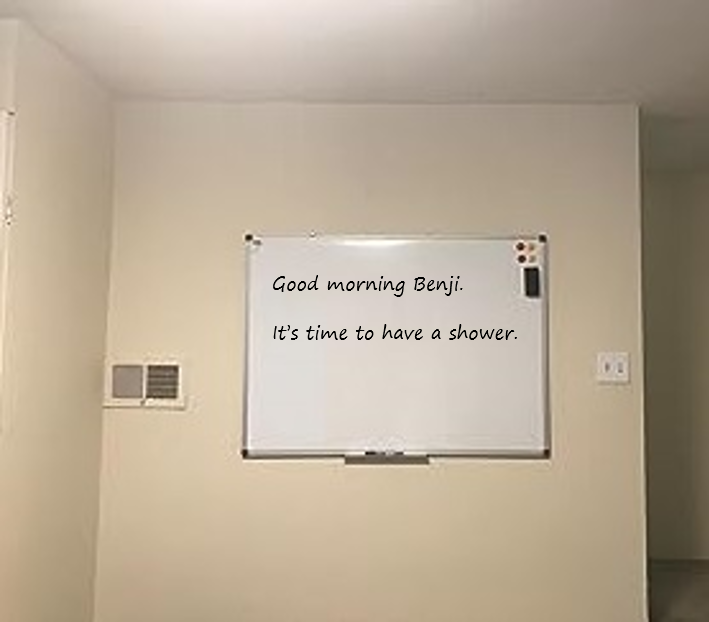
His occupational therapist thought about other supports, and talked to Benji about the use of a whiteboard.
His occupational therapist explained how the whiteboard could:
- be put on the wall in his bedroom
- provide a visual prompt for him to have a shower every morning.
Benji’s outcomes
Benji thought a whiteboard in his bedroom would help him to remember to shower every morning.
His occupational therapist went to Benji’s home to set up the whiteboard.
The occupational therapist put the whiteboard on the wall at the end of his bed.
On the whiteboard, his occupational therapist wrote the words:
Good morning Benji, it’s time to have a shower.
The occupational therapist asked the support staff to collect information.
His occupational therapist wanted to find out if:
- Benji remembered to have a shower every morning
- Benji’s support workers had to remind him to have a shower.
The information was used to check the whiteboard:
- met Benji’s needs
- was right for him.
The support worker said that the whiteboard was helping Benji to be independent.
Benji no longer needed the support workers to remind him to have a shower every morning.