
This section of My Technology Space provides information and resources to assist allied health professionals and assistive technology advisors to understand more about the types of assistive technology that may be considered when supporting people following acquired brain injury.
There are many types of assistive technology that may be considered for use to assist with cognitive changes, and their impact on activity completion, after brain injury. Assistive technology may be useful in supporting the person with their memory, planning, organising and problem solving, and starting and completing activities, and may be implemented across various settings. Assistive products may also help the person with their everyday activities, such as study and/or work, their health and well-being, to become independent, to modify their home environment and/or vehicle use.
When choosing assistive technology, it is important to get to know the person and their goals, and then to think about the types of supports, including the types of assistive technology, that the person believes may be suitable for them to trial in the future including:
- Exploring the different types of assistive technology
- Reflecting on past experiences
- Considering the context of use
- How shortlisted options match to the person’s needs.
Select where you want to go on this page
Exploring types of assistive technology
This section of My Technology Space provides information and resources to assist allied health professionals and other assistive technology advisors to explore categories of assistive technology used for cognitive support following brain injury. The information provided may be useful in helping professionals to determine which categories may suit the person, linked to their activity preferences and goals.
The number of assistive technology products available to people requiring cognitive support is growing rapidly. Members of the My Technology Space team conducted a scoping exercise to understand the product types and categories currently available in the assistive product market, that could be used for cognitive support following acquired brain injury. You can find out more about the paper here.
The image below shows the twelve categories that were identified in the scoping exercise, including over 200 different products that could be used for cognitive support after brain injury:
- Smart Sensors
- Smart Lighting
- Time Management & Medication Reminder Devices
- Personal Alarms
- Home Safety / Security
- GPS Watches / Wearables
- Smart Switches
- Home Automation / Hubs
- Software / PC-based Assistance
- Smartphone / Tablet Applications
- Companion Robots
- Other
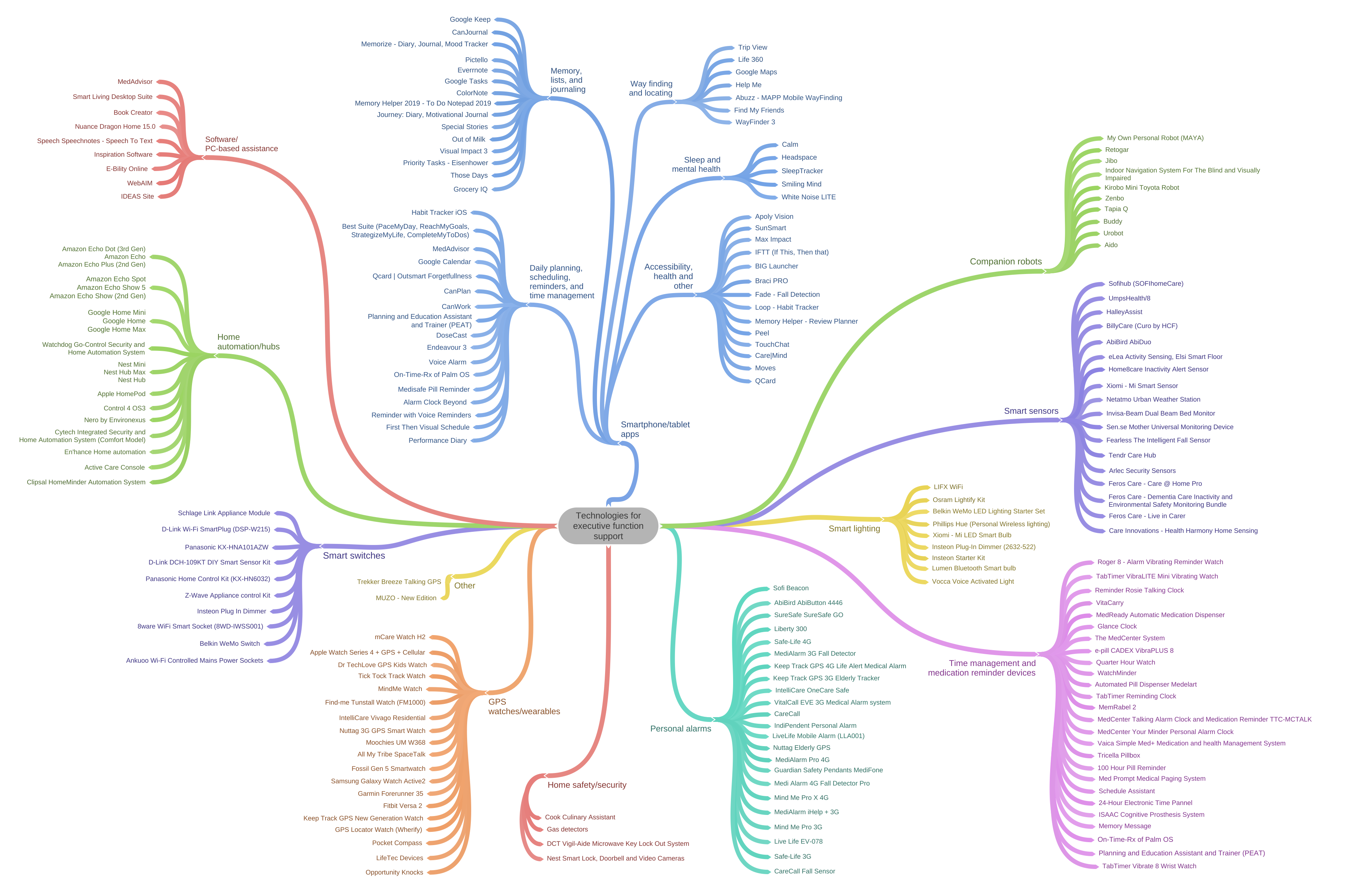
This range of assistive technology categories and large number of products highlights the challenge that exists for people with acquired brain injury, their families, allied health professionals and other assistive technology advisors in trying to stay abreast of the assistive technology product market.
In later sections of this website, there are tools and resources, including a Framework for the Evaluation of Assistive Technology, to help consider and evaluate different products.
You can find out more about different assistive technology by selecting from the different options below.
The information can help you work out:
- what supports they provide
- how they can help a person with acquired brain injury.
Select where you want to go on this page
Software for a device
There is assistive technology software a person can use on a device, like a computer, laptop, a tablet, or mobile phone.
You can download and install the software on a device.
Examples of assistive technology software are:
- Speech to text.
This can help a person communicate more easily. The person’s device can learn how they talk, and type what they say.
- Medadvisor.
This can help a person use medication safely. A person can see a list of all their prescription medications.
If they want, Medadvisor can tell them when they need to take their medications.
Medadvisor will tell them when they are running out of their medicine and need to see their doctor for a repeat prescription.
Medadvisor can also be used to ask for a repeat prescription.
Apps for a tablet or a mobile phone
There are assistive technology apps a person can download and install on a tablet or a mobile phone.
There are assistive technology apps to help:
- keep them healthy
- remind them to do things
- plan things for themself
- organise things for themself
- get started and complete activities in their day-to-day life.
Smart home hubs
Smart home hubs are assistive technology to help control the environment around a person. For example:
- open windows and doors
- open or close curtains or blinds
- turn on or off appliances in their home, like a TV, lamps, fan, air conditioner.
A person can control the environment from anywhere using:
- a device, like a computer, laptop, tablet, or mobile phone
- the internet.
Smart Switches
A smart switch is assistive technology to help a person use and control appliances in their home. For example:
- TV
- kettle
- lamps
- fan.
They can turn the smart switch on and off from anywhere using:
- a device, like a computer, laptop, tablet, or mobile phone
- the internet.
The person can also set a day and time when the smart switch is turned on or off.
Smart lighting
Smart lighting is an assistive technology product that connects to wifi in a person’s home.
A person can use smart lighting to:
- choose the colour of the bulb
- set a light to turn on or off at any time
- turn a light on or off using a device, like a computer, laptop, tablet, or mobile phone.
Smart lighting can be used to help a person:
- remember to do day-to-day tasks
- be independent.
Smart sensors
Smart sensors are assistive technology a person can use in their home to:
- keep them safe
- tell someone if they are unwell or had a fall
- help them do more things on their own
- develop skills.
The sensors can be put anywhere in their home. This includes on:
- doors
- drawers and cupboards
- beds
- furniture, like chairs and sofa.
The sensors can collect information about how they live in their home. For example when they:
- go to bed
- get out of bed
- take medication
- have a fall.
Smart sensors can be used to:
- talk to them
- send a message to someone in their support network, for example, family member, or a friend.
Wearables
Wearables are assistive technology that a person can wear on their body, like a smart watch.
Wearables can:
- keep them healthy
- remind them to do things
- plan things for themself
- organise things for themself
- get started and complete activities in their day-to-day life.
Some wearables include GPS trackers which can:
- help them find places in the community
- keep them safe.
Home Safety
Home Safety is assistive technology to help keep a person safe at home. For example:
- when they are cooking
- from appliances in their home
- when someone comes to their door.
Examples of Home Safety assistive technology are:
- gas detectors
- alarms
- security cameras
- locks for your door.
Personal alarms
Personal alarms are assistive technology that can:
- keep a person safe
- support a person to be independent.
Personal alarms can be used:
- at home
- when they are in the community
- where they work
- where they learn or study.
The personal alarm has a button they can press if they need help. For example if they:
- have a fall
- feel unwell.
A message can be sent to someone in their support network (such as a family member or friend) using:
- an automatic call
- a text message.
In an emergency they can also get help from emergency services.
Reminder timers and clocks
Reminder timers and clocks are assistive technology to help a person remember to do day-to-day tasks. For example:
- to take their medication
- to go to an appointment.
Reminder timers and clocks can help a person remember a task at any time of the day.
Reminder timers and clocks can help a person remember a task using:
- a voice message
- an alarm which plays a sound, or vibrates.
Reflecting on past experiences
This section of My Technology Space provides information and resources to assist allied health professionals and other assistive technology advisors to reflect on the things that have previously been successful - and those that have not - in providing the person with cognitive support, linked to their goals and needs.
It is important for allied health professionals and assistive technology advisors to understand what types of supports have been trialled previously or those the person is currently using. Identifying things that may have worked well in the past, or are working now, can be useful to consider during future product selection. Similarly, gaining an understanding of things that have not worked can provide valuable learnings that can then be factored into decision making related to future product use.
In addition to supporting the allied health professional or assistive technology advisor with their clinical decision making about future product trial and selection, the process can be of equal benefit to the person with brain injury, their families and key supporters. Being able to pinpoint enablers and barriers to assistive technology use from past experiences may be helpful to grow assistive technology use over time, and reduce the risk of product abandonment. It may also help to offer insights to the need for future assistive technology, the product features important to the person and/or their key supporters, and any training requirements that may be necessary for product uptake and use.
Below is a checklist of any of the different types of assistive technology the person currently uses across all categories of assistive products. This may help to document and understand what types of assistive technology supports have been trialled previously, or those the person is currently using.
Considering context of future use
This section of My Technology Space provides information and resources to assist allied health professionals and other assistive technology advisors to explore the contextual factors that may be important to consider with the person with brain injury, linked to their activity preferences, goals and assistive technology options.
Contextual features in a person’s life require careful consideration when thinking about assistive technology options for future use. These factors can be enablers or barriers to the use of assistive products. As a result of various contextual factors, an assistive product may be successfully implemented with one person but not so for someone else, even though their cognitive support needs may be similar.
Contextual factors to consider can include:
- Who the person lives with, including both family and friends as well as pets - this is particularly important when considering using movement sensing technologies for cognitive support, or where other residents may be impacted by technologies used in a particular space
- Social networks available to the person, whether they live with the person or not - it is important to think about availability of supporters to troubleshoot any issues arising, as well as to consider the level of digital literacy of that network to enable technology uptake and use over time.
- The person and their family’s cultural background - in some cultures, providing support from another person rather than a piece of technology may be viewed as more acceptable, and it is important to explore and identify where that may be the case and factor it in to any consideration of technology trials
- Education and literacy levels - consideration that some technologies rely on a high level of education and literacy to understand and learn their use, whilst others can be set up by others such that they don’t require input from the user is important and may be factors into decision making
- Internet connectivity - many assistive technologies used for cognitive support rely on internet connectivity and data plans - it is important to ensure that any assistive technology options being considered are affordable for the person, and have available both reliable internet connectivity and data allowances where assistive products require this.
- Disability or injury insurance funding rules for assistive technology - some people may have access to disability or injury insurance (e.g., the National Disability Insurance Scheme; the Transport Accident Commission or icare NSW funding) that may provide some support for assistive products or services to assist planning. However, rules vary across these Schemes about what can or cannot be funded in the area of assistive technology, and thus are important to understand.
You may like to read about the types of assistive technology considered with Imani - select here to read Imani’s story.
Shortlisting options matched to the person’s needs
This section of My Technology Space provides information and resources to assist allied health professionals and other assistive technology advisors to explore how shortlisted options match the person’s goals, activity preferences and needs.
Using the information gathered to consider the types of assistive technology that could be suitable, leads to a narrowing down to create a short-list of assistive products for possible trial. Environmental and contextual factors, the person’s past assistive technology experiences and preferences, their activity goals and aspirations for the future should all have been considered and documented. A Framework for the Evaluation of Assistive Technology to help consider and evaluate different products across nine key domains is provided in the next section of this website.